
The Real Reason Some Meetings Go Nowhere
A meeting can feel complete and still leave everything unchanged, which is exactly why so many teams keep repeating the same conversations without realizing what is actually blocking progress.
People speak, ideas move, perspectives are shared, and the discussion flows in a way that feels structured and engaged. Time passes without confusion, participation looks balanced, and the room carries enough activity to create the impression that something meaningful is happening. That feeling is convincing because it mirrors what productive work is supposed to look like.
Then the meeting ends, and nothing actually moves forward.
The same topic returns later, often with the same people, and the discussion starts again with slightly different language but the same lack of direction. That repetition is the real signal, because it shows that something inside the meeting is allowing the conversation to continue without allowing it to conclude.
The surface of the meeting works.
The outcome never forms.
When the Conversation Starts Reacting Instead of Addressing
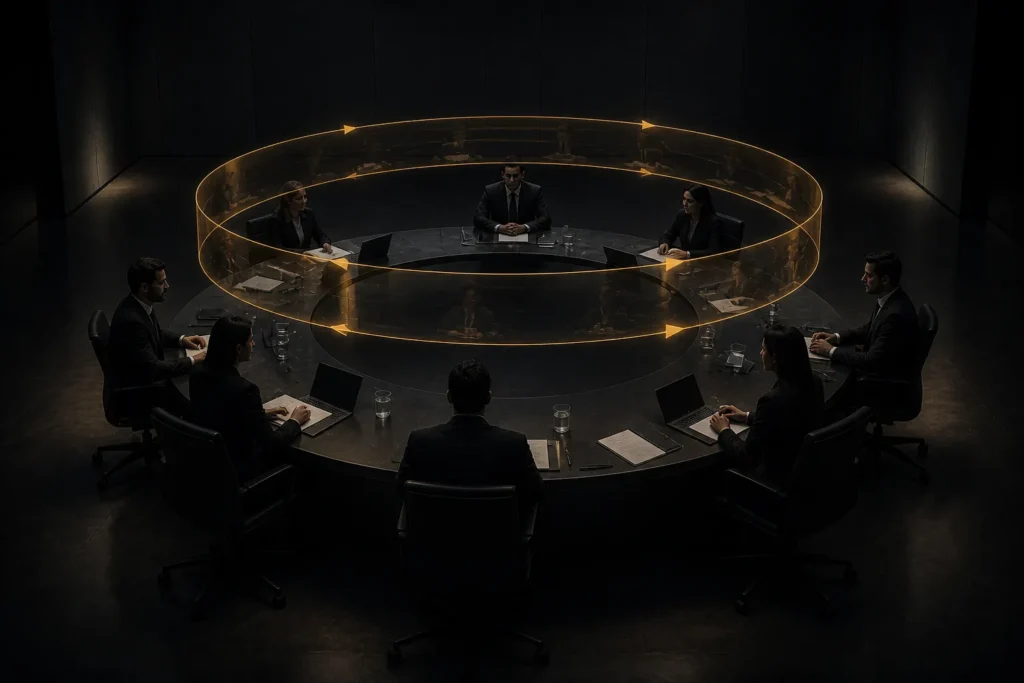
A meeting begins losing its value when the conversation shifts away from the issue itself and starts adjusting around the pressure connected to it.
Every meaningful topic carries consequences. Decisions affect outcomes, ownership, priorities, and perception. That weight enters the room even if no one names it, and once it is present, it begins shaping how people participate.
Participants start choosing language that keeps the discussion balanced. They hold back from pushing a point to its natural conclusion, they reframe ideas to sound more acceptable, and they approach the topic from angles that feel easier to explore. The conversation continues to move, yet it moves in a way that reduces pressure instead of resolving it.
This shift does not look like avoidance on the surface. It looks like professionalism, collaboration, and control. That is what makes it difficult to challenge, because everything sounds reasonable while the core issue remains untouched.
The meeting becomes active around the problem without ever going through it.
What Is Actually Missing in Most Unproductive Meetings
Once pressure enters the discussion, the room begins regulating itself without needing explicit rules.
People become aware of tone, perception, and reaction. They measure how far they can go without creating discomfort, how strongly they can express a concern, and how their input will affect the flow of the room. This awareness shapes every contribution, even when no one acknowledges it directly.
The conversation becomes controlled in a way that feels stable.
It remains structured, it avoids sharp turns, and it keeps everyone within a range that feels acceptable. That stability is often mistaken for effectiveness, yet it comes at a cost because it filters out the part of the discussion that would create movement.
The issue is still present, yet it is being approached in a way that keeps it contained rather than resolved.
Over time, the meeting becomes a space where people manage how things are said instead of focusing on what needs to be clarified.
Why Words Are Not Enough Without Direction
When a meeting leads nowhere, the default reaction is to improve communication, which usually results in better structure, clearer agendas, and more organized discussion.
Those improvements make the conversation easier to follow, yet they do not change what the conversation avoids. The meeting becomes more efficient in how it speaks without becoming more effective in what it solves.
More words do not bring clarity when the core issue is still being approached indirectly. A well-structured discussion can continue for an hour and still leave the central point untouched if the attention remains on what feels acceptable to say instead of what needs to be addressed.
This is why teams can revisit the same topic multiple times without moving it forward. Each meeting adds more language, more explanation, and more context, yet the decision that would change direction never fully forms.
The conversation expands.
The outcome stays incomplete.
That gap is what keeps the cycle going.
The Difference Between Discussion and Resolution
A meeting starts creating movement when attention stays with the issue long enough for it to be understood and decided on without being redirected by the pressure around it.
This requires recognizing when the discussion begins to drift and bringing it back without softening the point. It requires allowing the conversation to reach the part that feels uncomfortable because that is often where clarity begins to form. It requires holding the focus on what needs to be decided until a clear direction becomes visible.
This shift changes how the room operates.
The discussion becomes more direct, the thinking becomes sharper, and the outcome starts taking shape because everyone is now working on the same point instead of circling around it. The room may feel less smooth for a moment, yet it becomes more useful because it is finally doing what the meeting was meant to do.
Clarity does not appear through comfort.
It appears when the conversation reaches the point where something can actually change.
FAQs
Why do some meetings feel productive but lead to nothing?
Some meetings feel productive because people are talking, sharing ideas, and staying engaged, but the conversation is not moving toward a clear decision. When the real issue is avoided, activity fills the room and gives the illusion of progress.
How do you fix unproductive meetings?
Unproductive meetings improve when the real issue is named before the discussion starts. The meeting needs a clear purpose, a specific decision to reach, and enough focus to keep the conversation from circling around discomfort instead of resolving the problem.
That is why some meetings go nowhere. Everyone keeps talking because the real point is still untouched. The BreakAlign Method helps you catch that moment before one avoided decision turns into five more meetings.