

How Clarity Drives Momentum
Momentum does not disappear suddenly, it fades while everything still looks active and functional from the outside.
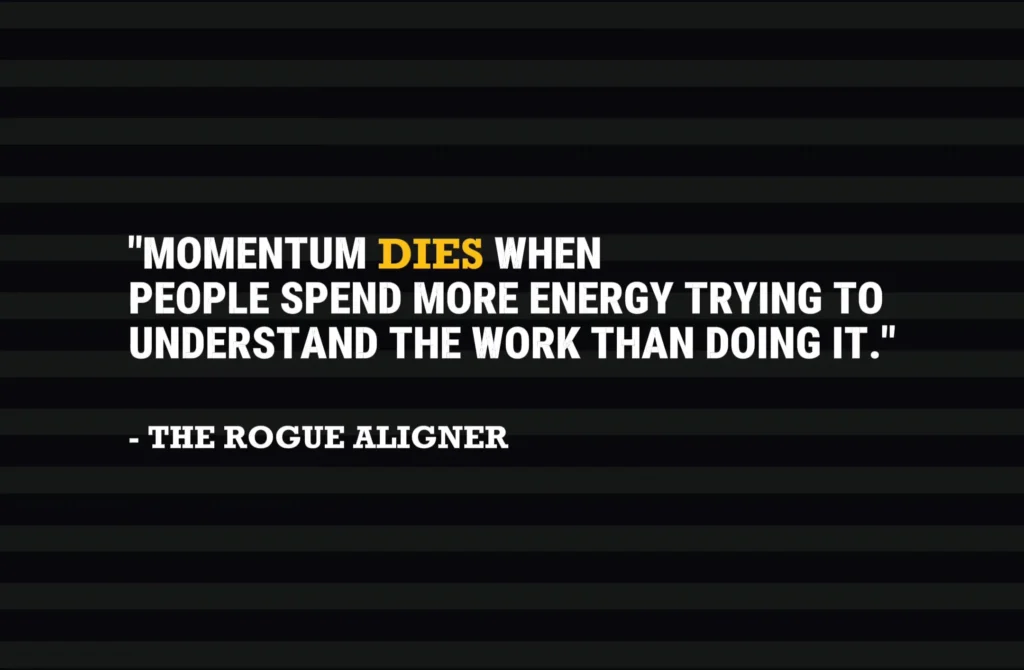
Work continues, meetings happen, tasks move forward, and people stay busy. Nothing appears broken, yet something starts feeling heavier underneath. Decisions take longer, movement slows, energy drops, and even simple actions begin to require more effort than they should.

That shift is easy to misread.
Most people respond by increasing pressure. They add urgency, more follow-ups, more discussions, and more control. It feels like the right response because it creates movement, yet that movement often misses the real issue.
Momentum does not fade because people stopped trying.
It fades because direction stopped being clear.
What Momentum Actually Requires
When direction is unclear, effort stops translating into progress.
People still work, yet their work no longer moves in a clean line. Decisions require more time because there is no clear reference point. Conversations repeat because alignment is not fully established. Work gets revisited, adjusted, and reconsidered more often than it should.
The system stays active, yet it starts working against itself.
This is where effort turns into friction.
People are not stuck because they are doing less.
They are stuck because they are moving without clarity.
That creates an uncomfortable reality.
Some teams are not lacking momentum because they need more effort.
They are lacking momentum because their effort has no clear direction.
Why More Pressure Does Not Restore Momentum
When momentum slows, pressure often increases.
Leaders push for faster decisions. Teams add more meetings. People try to compensate by working harder and moving faster. That response feels logical because it creates visible activity, yet it often deepens the problem.
Pressure does not create clarity.
It amplifies confusion when direction is not already clear.
More discussions do not resolve uncertainty when the core question has not been answered. More urgency does not improve decisions when people do not know what they are deciding toward.
This is where many systems get stuck.
They try to solve a clarity problem with effort.
That never works.
It only increases the cost of confusion.
How Direction Creates Forward Motion
The moment direction becomes clear, the system changes immediately.
Decisions become faster because they no longer fight uncertainty. People stop second-guessing because the next step becomes obvious. Work starts moving in a clean sequence instead of spreading across multiple directions.
Momentum returns without being forced.
This is important to understand.
Momentum is not something you create through pressure.
It is something that appears when resistance is removed.
Clarity removes that resistance.
Once people know what matters, what comes next, and where things are actually going, movement stops dragging. Energy returns to the work because people are no longer spending it trying to navigate confusion.
That shift is noticeable.
Work feels lighter. Thinking becomes sharper. Execution becomes cleaner.
Nothing external changed.
The system simply became clear.

What Happens When Direction Is Missing
When direction is vague, energy gets consumed without creating real movement.
People work, tasks get completed, and time passes, yet nothing feels like it is advancing in a meaningful way. That creates a slow drain that is difficult to explain because effort is still present.
The problem is not always workload.
It is the cost of moving through uncertainty.
Every unclear decision requires more mental effort. Every vague goal forces people to interpret what matters instead of acting on it. That constant interpretation consumes energy and slows everything down.
Over time, people start feeling tired without understanding why.
They are not overloaded.
They are misaligned.
That is a harder problem to detect because it hides behind activity.
The Clarity-Momentum Feedback Loop
Real momentum does not come from speed or pressure.
It comes from clarity that allows movement to sustain itself.
When direction is solid, people move with less resistance. Decisions connect naturally to each other. Work progresses without constant correction. Energy stays within the system instead of being wasted on confusion.
This is what makes momentum stable.
It does not need to be forced.
It continues because the system supports it.
That is also where another uncomfortable truth appears.
Momentum is not a sign that people are working harder.
It is a sign that they are no longer working against uncertainty.
FAQs
How does clarity drive momentum?
Clarity removes the effort spent on figuring things out. When people know what matters and what comes next, decisions happen faster and movement becomes consistent without needing pressure.
Why does momentum disappear even when people are still working?
Momentum fades when direction becomes unclear. Work continues, but effort spreads instead of moving forward because people are no longer aligned on where things are going.
Once you see this, weak momentum stops looking like a motivation problem. It becomes a direction problem. The work feels heavy because the system is trying to move while still unclear about where it is going. Pressure will only make that harder. Clarity removes the drag. If you are ready to stop forcing movement and start restoring direction, this is where you fix it: The BreakAlign Method.